Hope

I am on the email list for a group called Jewish Voice for Peace. They are calling on as many people as possible to sign a letter to the new Obama administration in support of working towards a fair and just peace between Israel and Palstine. Jewish Voice for Peace and Just Foreign Policy are aiming to deliver this letter on February 23. If you would like to add your name to this letter click here.

Here is the letter:

Dear President Obama,
Your presidency marks the beginning of a new era in America and in the world. Against all odds and maybe even our own better judgment, you taught us to hope again. Now, the crisis in Gaza demands that you match our hope with real progress. And, just to be clear, those who voted for you aren’t the only ones doing the hoping.
We are Americans who voted for you and we are Palestinians and Israelis a world away. We are the women, men, and children who are suffering every single day in Gaza and Israel and we are the people who seek to heal their suffering. We are mothers of soldiers and children of refuseniks. We are Jews and Muslims, Christians and Atheists. We are united in our call to you today:

Please, support peace for the people of Gaza and Israel.

Press for an end to the blockade of Gaza, so that the people there can have food, medicine, fuel, and basic necessities. That is the only way that they can live, thrive, and rebuild their economy.
Talk to everyone, including Hamas. The late Israeli Foreign Minister Abba Eban said, “You make peace by talking to your enemies.” This holds true today. Even a majority of American Jews support negotiations even with Israelis “worst enemies.”
Back up talk with actions. This includes monitoring arms smuggling into Gaza and U.S. military aid to Israel. Theseweapons are killing mostly children and civilians.
And, support the Peace Plan. 57 countries around the world support this plan that provides independence and support for both Israel and Palestine. Peace Plan supporters won’t wait for the United States forever – and without the United States, it won’t happen. It’s that simple.
President Obama, we will continue to hope, and to support your efforts. Please, don’t let us down. Please deliver the promise of hope.
Signed,
Your Name Here

Gather the Women for the 5th Women’s World Conference

The message to all women of the world is, “Wake Up! Arise! Do not ask for permission to gather the women. What cannot be done by men, or by individual women, can be done by women together. Earth is Home.”

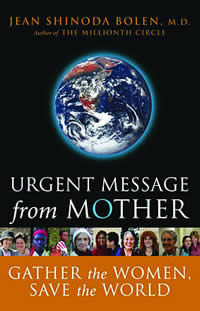
The quotation above comes from the book Urgent Message from Mother: Gather the Women and Save the World. It is an urgent message and an empowering one. “When women are strong together, women can be fiercely protective of what we love.”


Author Jean Shinoda Bolen, M. D. is a psychiatrist, Jungian analyst, clinical professor of psychiatry at the University of California San Francisco, a Distinguished Life Fellow of the American Psychiatric Association and recipient of the Institute for Health and Healing’s “Pioneers in Art, Science, and the Soul of Healing Award”. She is a former board member of the Ms. Foundation for Women. She also authored the following books: The Tao of Psychology, Goddesses in Everywoman, Gods in Everyman, Ring of Power, Crossing to Avalon, Close to the Bone, The Millionth Circle, Goddesses in Older Women, and Crones Don’t Whine.

Urgent Message from Mother is a call to activism. Other well-known figures and writers have also heard the call and have responded to the message in the book. Here are some of those responses:

“Jean Shinoda Bolen’s Urgent Message from Mother is a book whose time has come. Our earth home and all forms of life in it are at grave risk. We men have had our turn and made a proper mess of things. We need women to save us. I pray that many will read Bolen’s work and be inspired then to act appropriately. Time is running out.” Desmond Tutu
“This is the most inspiring and optimistic book I’ve read in years. It tells how women working together can bring us peace and save the planet. Jean Shinoda Bolen invites us all to join the next, most powerful wave of the women’s movement. Count me in!” Isabel Allende

“Always urging us into circle and into peace, the healing power of Jean Shinoda Bolen’s work and thought transforms all who will allow encounter. Jean never tires of wanting, and working for, our freedom, our healing and our health.” Alice Walker

“Jean Shinoda Bolen shows us how the cult of masculinity is endangering us all. Women and men are equally human and fallible but at least women don’t have our masculinity to prove — and that alone may make us the main saviors of this fragile Spaceship Earth.” Gloria Steinem

“Urgent Message from Mother is a heart-shaking book which offers a powerful vision of why the world must change and how such a pivotal undertaking might be accomplished. In these compact pages Jean Shinoda Bolen courageously brings us to the brink of an erupting and necessary wisdom and to a feminine spiritual activism whose time is here and now.” Sue Monk Kidd, author of The Mermaid Chair and The Secret Life of Bees

“Never have we needed the wisdom of Jean Shinoda Bolen more. This book brought me back to my spiritual center reminding me how much we need the stories of women to restore empathy to the world. Bolen has given us all an assignment: Gather, circle, act. Mother Earth is asking for our help. How can we not respond?” Terry Tempest Williams, author of The Open Space of Democracy

In her own effort to answer the call from Mother, Jean has been diligently working towards influencing the United Nations to sponsor a Fifth Women’s World Conference (5WWC). The first four conferences were sponsored by the United Nations. The last was held in Beijing in 1995 and produced the Beijing Platform for Action, which if fully implemented on a global scale would make the world a safe place for women and children. This will be possible only when violence of all kinds—from domestic to war, is no longer acceptable.

Jean states that she believes in the “necessity for a UN 5th Women’s World Conference to implement principles and goals already stated in the Beijing Platform for Action, UN Security Council Resolution 1325, and the Millennium Development Goals. There is no need to create further documents. There is a huge need to mobilize the women of the world without which, there is a lack of motivation and resources needed to bring about gender balance or take care women, children and the planet. Unless it is a UN sponsored conference, women from many developing countries will be unable to get visas and support.”

Now at the beginning of the 21st century with the state of the world as it is, it is a crucial time for women to come together to make a difference. This conference would be the first since the Internet made worldwide communication easy and would likely be the largest and most effective gathering of women ever held. It would accelerate reaching a tipping point. What this means is that when a critical number of people change how they think and behave, the culture will also, and a new era begins.

Meeting in small circles, women changed the face of our culture in the 20th century. Women in small circles grew into the Women’s Suffragette movement and women in consciousness-raising groups led to the women’s movement of the 1970s. The Millionth Circle is a movement led by women to change planetary consciousness. It is believed that the inclusion of women circles from around the world would create an influence that would be a major step toward a change in planetary consciousness through the active involvement of women at every level of society.

In Jean’s own words “Women who stand together for justice and peace are a moral force. The United Nations now has moral authority greater than any government or institution.We need each other and the world needs us to come together for there to be peace. We need a UN women’s conference so that the Beijing Platform for Action and Resolution 1325 will become an implemented worldwide women’s agenda.We need to gather the women, save the world.”

Now is the time for action by all women and all women circles around the world. There is hope that in 2009 the UN will make a decision to support the convening of the 5th Women’s World Conference. If planning begins now the goal will be to hold the conference in 2012.

One action everyone can take is to sign the on-line petition in support of convening a 5th Woman’s World Conference. You can access the on-line petition by clicking here. Or if you prefer you can print one out to share with your circle of friends and family and then mail it in. The directions are on the bottom of the form. Click here for the printable version.

If you would like to read more about this subjext please visit the web site for the 5th Women’s World Conference by clicking here. If you would like to learn more about Jean Shinoda Bolen and the Millionth Circle you can do so by clicking here.

Martin Luther King Jr.

Today I participated in celebrating the life of Martin Luther King, Jr. by joining in a community prayer circle and then a march to the local Martin Luther King Center. The image above is a wonderful mural that is painted on an outdoor wall at the center. Included on the mural are Dr. King’s Six Principles of Non-Violence. A few have been abbreviated. I wanted to share the full versions in honor of this special day.
1. Nonviolence is a way of life for courageous people.

2. Nonviolence is an effort to achieve a reconciled world by raising the level of relationships among all people to a height where justice prevails and persons attain full human potential.

3. Nonviolence attacks forces of evil and acts of evil, but never persons as evil. Nonviolence believes in the ultimate good of every person and seeks reconciliation.

4. Nonviolence accepts suffering without retaliation for its moral power toward achieving a goal.

5. Nonviolence avoids internal violence of the spirit as well as external physical violence.

6. Nonviolence believes that the moral arc of the universe bends toward justice.

“Nonviolence is absolute commitment to the way of love.
Love is not emotional bash; it is not empty sentimentalism.
It is the active outpouring of one’s
whole being into the being of another.”

Martin Luther King, Jr. 1957

The Virtues Project

The Virtues Project ™ was founded in 1991 by Linda Kavelin-Popov, her husband Dr. Dan Popov and her brother, John Kavelin who made a commitment to do something to counteract the rising violence among families and youth. They researched the world’s diverse sacred traditions, and discovered more than 360 virtues at the heart of all beliefs about the meaning and purpose of life. They self-published a book to help parents bring out the best in themselves and their children, The Family Virtues Guide.

According to the literature written about the Virtues Project, ‘Virtues are the qualities of our character. Values are whatever we consider important. We can value anything from money and power to the Golden Rule. Values are culture-specific, while virtues such as courage, honor, justice, and love are the common elements of character and spirituality universally valued by all cultures. We may practice them differently from one culture to another.’Additional literature declares, “The Virtues Project ™is not about the practices or beliefs of any one religion. It is sourced in the teachings about virtues found in the sacred traditions of all cultures. Its purpose is to support all people, both those who are religious and those who are not, to awaken the virtues of their character. The working definition of spirituality used in The Virtues Project ™is:

Having a sense of meaning and purpose.
Living with integrity, according to a person’s highest beliefs and values.
Mastery of the virtues of our character.
A sense of reverence for life and for all people.

In 1993, during the International Year of the Family, the United Nations Secretariat and World Conference of Cities and Corporations honored The Virtues Project ™ as a model global program for families of all cultures.

“The purpose of The Virtues Project ™ is to provide life-skill strategies that make the knowledge and practice of virtues accessible to people of all cultures. The Five Strategies help individuals to live more reverent, purposeful lives, support parents to raise children of strong moral character, inspire excellence, commitment and service in the workplace, and help schools and communities to build a climate of safety and caring.”

The Five Strategies of The Virtues Project ™ are:

1. Speak the Language of the Virtues.
Language has great influence to empower or discourage. Self-esteem is built when shaming or blaming language is replaced by naming the Virtues, our innate qualities of character. Virtues are used to acknowledge, guide and correct. The Language of Virtues helps us remember what kind of people we want to be.

2. Recognize Teachable Moments.
This strategy is a way of viewing life as an opportunity for learning, recognizing our mistakes, our tests and challenges as opportunities to honor our virtues. It is an approach to bringing out the best in each other by asking, “what can I learn from this situation?”, “What do I need to do differently next time?” and “How can I make it right?” Any moment that we bring our focus upon a virtue that is needed or demonstrated is a teachable moment.

3. Set Clear Boundaries.
Clear boundaries, connected to a Shared Vision of the virtues with which we want to treat one another, help to prevent violence and create a safe learning environment. Clear ground rules based on virtues build an atmosphere of order and unity. This strategy offers a positive approach to discipline, emphasizing both assertiveness and restorative justice. It helps us to identify what bottom line behaviors will not be tolerated as well as how amends can be made. Clear boundaries set children up to succeed.

4. Honor the Spirit.
School spirit grows through simple practices that illumine our sense of values, such as creating Shared Vision Statements. A school-wide moment of silence each morning can bring a sense of peace to the day. Virtues Sharing Circles allow us to reflect on what matters to us. Participation in the arts honors meaning and creativity. Celebrations make special events meaningful. This strategy helps us to address the spiritual dimension in a way that respects our diversity.

5. Offer the Art of Spiritual Companioning™
This is an art and skill which supports healing, encourages moral choice, and allows the safe expression of feelings. It helps in counseling, conflict resolution, and disciplinary situations. Companioning helps us to get to the heart of the matter when individuals are in grief or crisis. It invokes true presence and listening, asking clarifying questions, which allow individuals to empty their cup, and then to solve their own problems with the help of virtues.

SPEAK THE LANGUAGE OF THE VIRTUES
(To see a list of Virtues identified by The Virtues Project ™, please refer to the list that follows at the end of this post.)

How To Give a Virtues Acknowledgment
The 3 elements: opening phrase, virtue, and situation.

OPENING PHRASE VIRTUE SITUATION
I see your kindness in helping your sister. I honor you for your kindness in the way you helped your sister. I acknowledge you for your kindness in the way you helped your sister. That took a lot of kindness to help your sister when you were busy. It was kind of you to help your sister. You were being kind when you helped your sister.

How to give a Virtues Instruction/Guidance or Correction

OPENING PHRASE VIRTUE SITUATION
You need to be patient while you wait for dinner. Please be kind to your sister. What would help you to be peaceful with your sister now? I need some consideration. Please turn down the music. How can I support you to be self-disciplined about remembering your homework?

The 5 Strategies and Speak the Language is copyrighted material. For more information about the Virtues Project, visit their website at http://www.virtuesproject.com/

A List of the Virtues

Acceptance
Accountability
Appreciation
Assertiveness
Awe
Beauty
Caring
Charity
Cheerfulness
Cleanliness
Commitment
Compassion
Confidence
Consideration
Contentment
Cooperation
Courage
Courtesy
Creativity
Decisiveness
Detachment
Devotion
Dignity
Diligence
Discernment
Endurance
Enthusiasm
Excellence
Fairness
Faith
Faithfulness
Fidelity
Flexibility
Forbearance
Forgiveness
Friendliness
Generosity
Gentleness
Grace
Gratitude
Helpfulness
Honesty
Honor
Hope
Humanity
Humility
Idealism
Independence
Initiative
Integrity
Joyfulness
Justice
Kindness
Love
Loyalty
Mercy
Mindfulness
Moderation
Modesty
Nobility
Obedience
Openness
Orderliness
Patience
Peacefulness
Perceptiveness
Perseverance
Prayerfulness
Purity
Purposefulness
Reliability
Resilience
Respect
Responsibility
Reverence
Righteousness
Sacrifice
Self-Discipline
Serenity
Service
Sincerity
Steadfastness
Strength
Tact
Temperance
Thankfulness
Tolerance
Trust
Trustworthiness
Truthfulness
Understanding
Unity
Uprightness
Wisdom
Zeal

Spirals

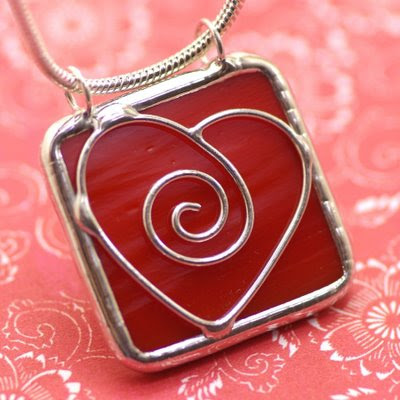
Pendant by Becky Sharp of Becky Sharp Designs
(Read below for information about this item.)

Swirls and spirals are an image I have been drawn to since forever. Recently I was doing some research about this symbol.

Information I took from Wikipedia is as follows:

The spiral is the most ancient symbol found on every civilized continent. Due to its appearance at burial sites across the globe, the spiral most likely represented the “life-death-rebirth” cycle. Similarly, the spiral symbolized the sun, as ancient people thought the sun was born each morning, died each night, and was reborn the next morning.
The spiral plays a certain role in symbolism, and appears in megalithic art, notably in the Newgrange tomb or in many Galician petroglyphs such as the one in Mogor. See also triple spiral. While scholars are still debating the subject, there is a growing acceptance that the simple spiral, when found in Chinese art, is an early symbol for the sun. Roof tiles dating back to the Tang Dynasty with this symbol have been found west of the ancient city of Chang’an (modern-day Xian).
The spiral also represents infinance, or ‘infinity.’ Starting at a single point, and revolving outwardly until the end of the universe. Because of this, some civilizations believe that the Spiral is a pathway to the afterlife.
The study of spirals in nature have a long history, Christopher Wren observed that many shells form a logarithmic spiral. Jan Swammerdam observed the common mathematical characteristics of a wide range of shells from Helix to Spirula and Henry Nottidge Moseley described the mathematics of univalve shells. D’Arcy Wentworth Thompson‘s On Growth and Form gives extensive treatment to these spirals.
As part as seeking out images of spirals I came across an artist who makes jewelry. The gorgeous heart with the spiral is one of her designs. I am so loving her jewelry and the wonderful spirals that appear on many of them. It just so happens that through another blog you can enter to win the beautiful and stunning heart pendant. You can also take advantage of a 25% discount being offered when making a purchase of Becky’s jewelry. Please visit the blog Finding the Joy In the Journey here and Becky’s website called Becky Sharp Designs by clicking here.

When Parenting Does Not Come Easy


Self esteem doesn’t come from “being the best,”
it comes from valuing the best one can be.
~Beth Wilson Saavedra

No one ever really knows what it is like to be a parent until they become one. Parenting has not come easy to me. As a person who wondered how she would handle one child, having twins has at times felt overwhelming. There are great joys but I also experience great frustration at times. There was a period of time where I grew depressed and very down on myself. I judged myself harshly. I compared myself to others and always found myself lacking and inadequate.

There are inherent problems with comparing oneself to other parents and I found that Beth Wilson Saavedra captured this well in her book Meditations for New Mothers. She writes, “As mothers, we compare ourselves to other mothers. We try to model ourselves after the mothers we respect. When our lives don’t look like theirs, however, we feel like failures. We forget that we aren’t the same people, living in the same house, with the same bank account.

Our children, too, are different, and they challenge us in different ways. The circumstances of their births, the level of their needs, and the diversity of their personalities, all create unique scenarios that must be dealt with in a way that is fitting for them. We must ‘row with the oars we have.’ They’ll probably prevent the boar from going adrift. There are two sides to every oar.”

Eventually I began to take steps to work through the depression. One powerfully proactive effort was to see a therapist regularly for a year. Being a reader I also turned to books for help and advice. A search for a practice of some kind, spiritual or not, also called to me. I began exploring Buddhism and have been meeting weekly with a small group to read books on Buddhism and discuss them. The group I meet with also chants as part of their practice. I initially found this to be very uncomfortable and foreign. It took me more than eight months to finally give it a try. I learned I just needed to customize the chanting to fit my needs. I have now added to this morning chanting ritual by writing morning pages as Julia Cameron recommends in her book The Artist’s Way right after. Sifting through random thoughts first thing in the morning has proven to be beneficial.

While contemplating what has helped me to pull out of my depression and my struggles with judging myself as a parent, I also discovered there were six more things that are helping me a great deal.

1) Knowing that I am not alone with finding parenting to be challenging, difficult, frustrating and even infuriating.

2) Having someone to talk with who will not judge me for my negative thoughts about parenting.

I have one friend here in town who is more than 10 years older than me. She chose not to have children as she really didn’t think she had the temperament nor the patience for it. She is a great person for me to talk to at times about things I don’t like about being a parent, things that drive me crazy or really make me grieve “life before children” (and marriage too.) I also find that sharing stories with her about parenting sometimes turn those events into very humorous and hysterical accounts when spoken aloud. She will crack up and also tell me at times – “Thank you for reminding me that I made the right decision not to have kids.” I in turn get insight into her single life without children. At times her life sounds so wonderful and free and at times I am more grateful for having a partner and children.

3) Reading books or writings that express what I have felt and am feeling, because it normalizes it.

For example Sarah Napthali writes in her book Buddhism for Mothers of Young Children, “We have all had moments as mothers when we are struck by where we have suddenly found ourselves. We might smile as we marvel at the new world we now inhabit and how far away it seems from our old world. Sometimes, we miss our old world, we struggle to surrender our former freedoms, our youth and all those evening, weekends and holidays to ourselves. Sometimes we look in our mirrors, look at our messy living rooms or at the clock that reds three in the morning, and ask, ‘Where am I?'”

I also really like this one that is also from the book Meditations for New Mothers by Beth Wilson Saavedra, “No matter how much time we take to prepare, childbirth dramatically changes our lives overnight. It is only natural to long for ‘life before baby.’ We think of the freedom we had. We could read a book until we finished it, hop on a plane to Paris, or throw a lavish dinner party. Whether or not we actually did these things is irrelevant. It’s the feeling that we could have done them that causes us to grieve for our lost freedom. It’s normal to feel confined after life-with-baby begins. it doesn’t mean we don’t love our child. It doesn’t mean we don’t enjoy being a mother. I have given up some things to be a mom. But they are not gone from me forever.”

4) Learning to not beat myself up for negative thoughts about parenting.

They are just thoughts. I don’t need to give power to these thoughts. I don’t’ need to judge myself for having these thoughts. I can just have them, observe them and then move on.

5) Understand that I have needs that need to be honored and respected. I need quiet at times. I need alone time. I need time to read, write and create.

Sometimes I take time to fulfill these needs while the girls are still sleeping in the early morning or at night. Other times I let my husband know I need to take a little time for me. This has been a hard one for me because there is a tendency to feel guilty for taking time away from my daughters when I work full time and I am already away from them 8 hours or more every day during the week. Yet I have found it necessary for my emotional well being. This is why I have been getting better at taking time for me and scheduling dates with myself. For example, already I am so looking forward to the fact that I have Martin Luther King day off in a couple of weeks and that the daycare is open that day. My plan is for the girls to do to daycare so that I can have a day to paint, write, listen to music and not give one ounce of myself to chores or answering to someone else’s needs.

6) I try not to compare myself to others, because this usually leads to feeling inadequate and feeling dissatisfaction with myself.

The other night my husband shared a beautiful statement about being a father and what it means to him and how he feels like he was meant to be a dad. It was touching and I immediately suggested he write it down so that one day the girls could read it. My thoughts also started to go to a place of comparing myself to him, because I didn’t exactly feel the same way. I don’t feel as if I was “meant to be a mom.” More often I feel that I am limping along in this role. I know I am not a bad mom, yet there is that element in me that wishes I was a great mom. There are probably moments when I am indeed a great mom, but I certainly don’t feel that all the time. Hearing my husband speak of how he so loves his role started to make me feel “less than.” Yet then I pulled up the reins on spiraling into that thought pattern.

I am learning to accept that I am doing the best that I can. I love my daughters and I express that love and I do a lot with them and for them. I am trying to learn to be satisfied with who I am and understand that the role of mom is not going to fulfill me completely. I know that I need more. I need interactions with adults. I need to be writing and reading and sharing ideas and thoughts with other people. I need to be contributing to more than my immediate family. I am learning that this is a good thing. I am a key role model for my daughters. As they grow I would like them to also discover what brings them joy, what makes their heart sing, and what makes their spirit soar. If they see in their mom a woman who loves what she does, feels inspired, dares to follow her dreams and live a life of fulfilling a vision and mission, then they can grow up with a greater sense of what is possible for themselves in their future.

Suggested Readings ~ If You Want to Write by Brenda Ueland (published in 1938)

“Like many of the most talented and funniest people, she is too nice and unconceited to work from mere ambition, or the far-away hope of making money, and she has not become convinced (as I have) that there are other reasons for working, that a person like herself who cannot write a sentence that is not delightful and a circus, should give some time to it instead of always doily-carrying, recipe-experimenting, child-admonishing, husband-ministering, to the complete neglect of her Imagination and creative power.
In fact that is why the loves of most women are so vaguely unsatisfactory. They are always doing secondary and menial things (that do not require all their gifts and ability ) for others and never anything for themselves. Society and husbands praise them for it (when they get to miserable of have nervous breakdowns), though always a little perplexedly and halfheartedly and just to be consoling. The poor wives are reminded that that is just why women are so splendid–because they are so unselfish and self-sacrificing and that is the wonderful thing about them!
But inwardly women know that something is wrong. They sense if you are always doing something for others, like a servant or nurse, and never anything for yourself, you cannot do others any good. You make them physically more comfortable. But you cannot affect them spiritually in any way at all. For to teach, encourage, cheer up, console, amuse, stimulate, or advise a husband or children or friends, you have to be something yourself. And how to be something yourself? Only by working hard and with gumption at something you love and care for and think is important.
So if you want your children to be musicians, then work at music yourself, seriously and with all your intelligence. If you want them to be scholars, study hard yourself. If you want them to be honest, be honest yourself. And so it goes.”

Welcome 2009!

Some people scoff and joke about New Years resolutions. They express skepticism at people really keeping “promises” to themselves about exercise programs, quitting smoking or losing weight. Yet there really is some deeper need within many that leads them to pause and give some extra consideration to what they wish to happen in the new year. The end of a year, after the busyness of the holidays, there can finally be a slowing down. It can be a very natural time to evaluate and contemplate.

I found that the entries for January 1st and January 2nd in Simple Abundance by Sarah Ban Breathnach offered very thoughtful ideas on greeting a new year. I am going to share the excerpts with you here:

January 1
A Transformative Year of Delight and Discovery

There are years that ask questions and years that answer.
~ Zora Neale Hurston

New Year’s Day. A fresh start. A new chapter in life waiting to be written. New questions to be asked, embrace, and loved. Answers to be discovered and then lived in this transformative year of delight and self discovery.
Today carve out a quiet interlude for yourself in which to dream, pen in hand. Only dreams give birth to change. What are your hopes for the future as you reflect on the years that have passed? Gradually, as you become curator for your own contentment you will learn to embrace the gentle yearnings of your heart. But this year, instead of resolutions, write down your most private aspirations. These longings you have kept tucked away until this time seems right. Trust that now is the time. Ask the questions. The Simple Abundance path brings confidence that the answers will come and we will discover – day by day – how to live them.
Take a leap of faith and begin this wondrous new year by believing. Believe in yourself. And believe that there is a loving Source — a Sower of Dreams — just waiting to be asked to help you make your dreams come true.

January 2
Loving the Questions

You only live once–but if you work it right, once is enough.
~ Joe E. Lewis

How often in the past have you turned away from all that is unresolved in your heart because you feared questioning? But what if you knew that a year from today you could be living the most creative, joyous, and fulfilling life you could imagine? What would it be? What change would you make? How and where would you begin? Do you see why the questions are so important?
“Be patient toward all that is unsolved in your heart and try to love the questions themselves,” the German poet Ranier Maria Rilke urges us. “Do not now seek the answers which cannot be given you because you would not be able to live them and the point is to live everything. Live the questions now…”
The answers to your questions will come, but only after you know which ones are worth asking. Wait. Live your questions. Then ask. Become open to the changes that that the answers will inevitably bring. This may take some time, but time is the New Year’s bountiful blessing: three-hundred sixty five bright mornings and starlit evenings, fifty-two promising weeks, twelve transformative months full of beautiful possibilities, and four splendid seasons. A simply abundant year to be savored.

Fat Cow

Fat cow.

I would say that most of the people I know wouldn’t dream of calling someone a fat cow. Saying something mean and hurtful like that just wouldn’t happen. While I don’t know Oprah Winfrey personally I would hedge a bet that she also wouldn’t dream of calling someone a fat cow. She is just too nice and too respectful to do such a thing. She is the type of person who works on helping people feel better about themselves. She sincerely wants people to have better self esteem. This is why she moved years ago to covering all the positive topics on her program.

It is interesting that while many of us wouldn’t consider calling someone else something like fat cow, we might easily take a verbal punch at our self and call our self a nasty name.

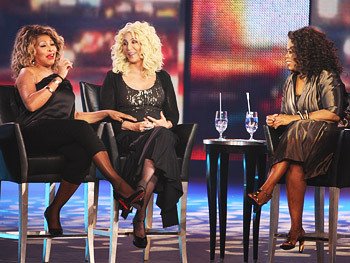
“I felt like a fat cow.” This is a statement Oprah makes in the January 2009 issue of her magazine. This particular remark was made in regards to her feeling she had hit bottom when she wanted to stay home from a show as fun as one with Tina Turner and Cher in Las Vegas. She said she was supposed to stand between them onstage and wanted to disappear. She added that she was thinking to herself, “God help me now. How can I hide myself?”

I went looking for photos of Oprah with Cher and Tina as I hadn’t seen the show. In the photo above I see Oprah looking attractive as usual. She is wearing some sassy heels and a gorgeous dress. When I finally found a clip of Tina and Cher performing Proud Mary at the end Oprah joins them on the stage. It was amazing to think that she actually thought she looked like a fat cow. Her dress was very flattering and she looked like she had a nice figure.

Truly I felt a little disturbed by Oprah’s comments about herself. When I think of Oprah my thoughts travel first to her amazing life story. I believe that Oprah has the following she does and is loved by thousands because of that life story. People love to see someone rise up from the bottom. She has succeeded in spite of being born to two young people who weren’t prepared to have a child. In spite of the poverty. In spite of being female and a minority. In spite of being molested as a young girl. In spite of working in a field that is very competitive. In spite of her weight.

Once my thoughts get past all of that I then think of all the good works she is doing in the world. Her school in South Africa for girls and the Angel Network are just two examples. Oprah is an amazing woman who is extremely hard working and intelligent. It is thinking about these accomplishments that makes it so sad to hear how she could be so reduced to focusing on the physical that she would feel like a fat cow. She also fell into the trap of comparing herself to others and in this case it was none other than Tina Turner and Cher. Oprah shared “As I interviewed them, I was thinking, ‘Who’s the real older woman here? I am. They didn’t just sparkle; they glittered.” I believe that MANY women, if put on the same stage with Cher and Tina Turner, would find themselves lacking if they began a comparison game.

Oprah talks about the struggles with some health issues, medications, and letting her life get out of balance, to the point she wasn’t making time for herself. She is honest about her frustration and how she began eating whatever she wanted. She says specifically “My drug of choice is food. I use food for the same reasons an addict uses drugs; to comfort, to soothe, to ease stress.” I also took note of her sharing a comment made by her friend and author Marianne Williamson. Marianne said “Your overweight self doesn’t stand before you craving food. She’s craving love.” Oprah added to that observation, “Falling off the wagon isn’t a food issue; it’s a love issue.”

Reading Oprah’s self disclosing article was also a powerful reminder to me about my own issues with my current weight. I too have felt embarrassed about my weight gain. I too have avoided gatherings, parties, photos, going to my old town with the fear of running into someone who would quickly notice how much weight I had gained. Like Oprah I also thought I had the weight thing all figured out and that the battle of the bulge was finally over once and for all. I worked out six to seven days a week for one to two hours for a good number of years. I watched what I ate all the time. It seemed like I could do that forever. It helped that I didn’t have a relationship or children. The two biggest portions of my life consisted of work and working out. I filled in all the other moments with playing on two volleyball teams, riding my bike, gardening, dancing, rollerskating, swimming, doing arts and crafts.

I think that some of us, maybe lots of us, have that tendency towards wanting perfection. I sense that even though Oprah says she wants her new program to be about her health and not about being thin, she also really wants to look like she did in 2005. She wants to look like Tina Turner and Cher. How many of us strive and desire to look like the stars and models who taunt us from the covers of magazines? This focus on how we look can create such dissatisfaction with ourselves. Even when I was a skinny size 10 and looked great in clothes and in workout wear I knew that I wasn’t completely satisfied with how I looked naked. I actually had thoughts that the only way I would ever look “perfect” was if I elected to have surgery.

I believe Oprah is right about health being the ultimate goal. Health is truly the golden chalice. If you do not have your health the quality of life can begin a tailspin off a cliff very quickly. I attended a conference where the speaker was a woman who had an impressive career as an endurance athlete. When she stood in front of the audience even I would admit she certainly didn’t look the part of an exceptional athlete. She wasn’t a model and she didn’t have an exceptional figure. In fact she was an older, shorter, slightly overweight woman. The people in that audience were from the local community and I recognized many as top trainers from the local gyms who happened to be impressive athletes in their own right. A number of these trainers happened to be in their 40’s and 50’s. I also knew some in their 20’s and 30’s and while some of them might fit the expected look of a gym trainer, that certainly didn’t pertain to all.

I ended up sitting next to a young man who introduced himself as a sales rep for body building supplements. He was attractive with muscles bulging. I suspect he was willing to talk to me because I was young, thin and had defined muscles of my own. As he looked around the room he stated that he expected to see more athletes and body builders at this talk. I figured he was looking to make some contacts, do some networking, with the ultimate goal of making some sales of his products. I realized as he spoke that he had no idea who was in that room. I shared with him that some of the top physical trainers from the local gyms were present and that many were impressive athletes. What I left unsaid is that he wasn’t recognizing this because these people weren’t matching his expectations of what you see in the magazines. Not all athletes or people with great health look like Olympic models. Not all athletes have muscles in all the right places.

It is an adjustment to anyone who has craved to look attractive and beautiful to change their mindset. There may be a certain internal struggle about “settling” and about not striving to be the best. Questions may start to spiral. Can I settle for being healthy? Can I settle for not attaining the type of thinness that the media propagates as ideal? Can I quit beating myself up? Can I quit feeling like I failed? Can I quit thinking that I am a disappointment to my husband? Can I quit fearing that I am an embarrassment to my children?

The deeper and more real questions to start posing are the following: What do I win for being thin? Am I a better person if I wear a size 6, 2 or zero? Will I really have the perfect life if I look perfect? What do I accomplish by beating myself up? What do I gain by pointing out all my flaws and imperfections? What good comes of comparing myself to others, especially women who find it necessary to meet the physical expectations of Hollywood?

The truth is that barraging oneself with negativity leads to lowering self-esteem, greater self loathing, depression, more fear, increasing stress and this can easily cycle into believing we are worthless. The worst case scenario is that it can even steal our desire to live.

We get to make choices about what really matters. Some may make career choices that dictate they need to look a certain way. I for one would never want a career that was based on my appearance. I believe that more people need to set examples about what really matters in this world. It shouldn’t be about looking like Tina Turner or Cher.

We are each unique with our own set of genetic DNA that can dictate a whole lot about the size of our behind or how easily we gain and lose weight. It is about time that we begin to truly value and respect diversity and that means not just diversity of skin color or culture. We need to respect that we aren’t all meant to be a size 0. We aren’t all meant to fit into a size 6 shoe. We aren’t all meant to be 6 feet tall with legs that last forever. A woman can be larger and healthy. Just as a woman can be skinny as a rail and completely unhealthy with high cholesterol and a heart condition.

Copyrighted to Himalayan Academy Publications, Kapaa, Kauai, Hawaii.
I would love to have a conversation with Oprah and remind her that in some cultures a fat cow is revered, almost like a God. A cow is one of God’s creatures. It is almost humorous that the poor cows are getting a bad rap from her again and this time it isn’t about their meat. Oprah was once sued by the beef industry and had to appear in court. The beef industry lost its case as it grew apparent she hadn’t meant to defame their industry intentionally. Hopefully the Hindus won’t take her to task for insulting one of their most sacred animals. They love all cows -fat, skinny, tall, short, young or old. It doesn’t matter. They all get the same amount of respect. Isn’t that how it should be for us all?

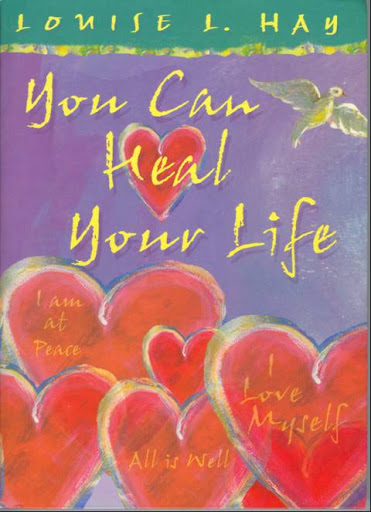
Suggested Reading ~ You Can Heal Your Life by Louise L. Hay
“Overweight is another good example of how we can waste a lot of energy trying to correct a problem that is not the real problem. People often spend years fighting fat and are still overweight. They blame all their problems on being overweight. The excess weight is only an outer effect of a deep inner problem. To me, it is always fear and a need for protection. When we feel frightened or insecure or “not good enough” many of us will put on extra weight for protection.
To spend our time berating ourselves for being too heavy, to feel guilty about every bite of food we eat, to do all the numbers we do on ourselves when we gain weight, is just a waste of time. Twenty years later we can still be in the same situation because we have not even begun to deal with the real problem. All that we have done is to make ourselves more frightened and insecure, and then we need more weight for protection.
So I refuse to focus on excess weight or on diets. For diets do not work. The only diet that does work is a mental diet—dieting from negative thoughts. I say to clients, ‘Let us just put that issue to one side for the time being while we work on a few other things first.’
They will often tell me they can’t love themselves because they are so fat, or as one girl put it, ‘too round at the edges.’ I explain that they are fat because they don’t love themselves. When we begin to love and approve of ourselves, it’s amazing how weight just disappears from our bodies.
Sometimes clients even get angry with me as I explain how simple it is to change their live. They may feel I do not understand their problems. One woman became very upset and said, ‘I came her to get help with my dissertation, not to learn to love myself.’ To me it was so obvious that her main problem was a lot of self-hatred, and this permeated every part of her life, including the writing of her dissertation. She could not succeed at anything as long as she felt so worthless.”

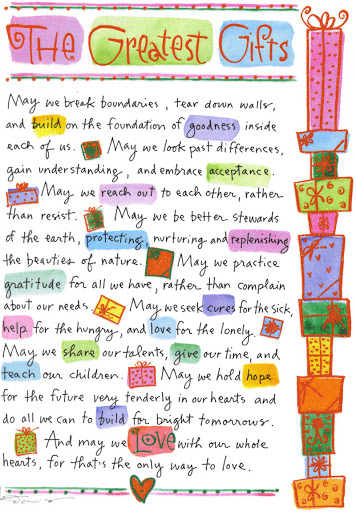
The Greatest Gifts

(Message and Design by Kathy Davis)

The Greatest Gifts

May we break boundaries, tear down walls,
and build on the foundation of goodness inside each of us.

May we look past differences,
gain understanding, and embrace acceptance.

May we reach out to each other, rather than resist.

May we be better stewards of the earth, protecting,
nurturing and replenishing the beauties of nature.
May we practice gratitude for all we have,
rather than complain about our needs.
May we seek cures for the sick,
help for the hungry, and love for the lonely.
May we share our talents,
give our time, and teach our children.
May we hold hope for the future very tenderly in our hearts
and do all we can to build for bright tomorrows.
And may we LOVE with our whole hearts,
for that’s the only way to love.

What We Can Learn from Anger

Anger is an emotion that is often viewed as negative and in some religious circles as sinful even. Yet anger is a human emotion, just like fear, happiness and sadness. Should anger be suppressed or ignored? What do we do with this emotion?

Let us consider a few individuals who are recognized for their contributions to peace. The idea of a person being both peaceful and angry may seem contradictory and incompatible. Yet I believe it is helpful and even encouraging for anyone who struggles with being angry to recognize that even some of the most peaceful people to walk this earth have experienced anger and expressed it.

Jesus
When Jesus cleared the temple of the moneychangers and animal-sellers, He showed great emotion and anger (Matthew 21:12-13; Mark 11:15-18; John 2:13-22). Jesus’ emotion was described as “zeal” for God’s house (John 2:17). Another time Jesus showed anger was in the synagogue of Capernaum. When the Pharisees refused to answer Jesus’ questions, “He . . . looked round about them with anger” (Mark 3:5). This verse goes on to give the reason for His anger: “the hardness of their hearts.”

Mahatma (Great Soul) Mohandas Karamchand Gandhi (1869-1948)
“I have learnt through bitter experience the one supreme lesson to conserve my anger, and as heat conserved is transmuted into energy, even so our anger controlled can be transmuted into a power which can move the world. It is not that I do not get angry. I do not give vent to anger. I cultivate the quality of patience as angerlessness, and, generally speaking, I succeed.… It is a habit that everyone must cultivate and must succeed in forming by constant practice.”

Mother Teresa
“When I see waste here, I feel angry on the inside. I don’t approve of myself getting angry. But it’s something you can’t help after seeing Ethiopia.” — Washington 1984.

Daisaku Ikeda (January 2, 1928-)
Ikeda is President of Soka Gakkai International (SGI), a Buddhist association which claims 12 million members in more than 190 countries and territories, and founder of several educational, cultural and research institutions. Ikeda is a peace activist, prolific writer, poet, educator, interpreter of Nichiren Buddhism and environmentalist. He has travelled to more than 60 countries to hold discussions with many political, cultural, and educational figures, as well as to teach. In his book For the Sake of Peace Ikeda writes in the preface “I am against war! I am absolutely opposed to it!” He continues on later with “I am determined to fight against anyone who supports or advocates war. I will fight the dark, demonic forces of destruction. Another book by Ikeda called Fighting for Peace is a collection of his meditations on war and peace. In a description from his own web site the book is described as expressing, from personal experience, his deep loathing of war and his anger at those in positions of authority who would sacrifice ordinary people in pursuit of selfish ends.

In learning to better embrace and accept myself, I have needed to recognize and accept my anger and even my rage. This has been a huge part of growing and becoming more authentic and real. I grew up repressing any anger I felt. Scary feelings like anger were stuffed away and suppressed. My fears of “rocking the boat” and of not being liked felt very overpowering. There is no doubt that I had the people-pleasing disease.

The book Quantum Wellness: A Practical and Spiritual Guide to Health and Wellness by Kathy Freston addresses anger and I had one of those “Aha moments” upon reading this section this summer.

Freston writes, “According to Dr. John Sarno, the emotion we are most averse to is rage, anger that has gathered steam from being kept down and locked away. A lot of people who think of themselves as good people — Sarno called them “goodists,” because they tend to be very much tied to an image of themselves as nice and good people — do not at all feel comfortable with such a “distasteful” and potentially out-of=control emotion as rage. If something happens in their life that sparks intense anger, these people tend not to deal with it, because they don’t like what it brings up in them…

…A goodist might well submerge his true feelings because he doesn’t want to rock the boat. He convinces himself that he has “let it go” when, in fact, by not allowing himself to experience his authentic emotions, they have just done unconscious. When we don’t think we can handle something in a way that feels safe and manageable –ie., if we speak up, we might lose a relationship or job or, even worse, be thought of as a bad person — our survival mechanism kicks in and buries the feeling in the recesses of our psyche. Those disowned feeling become part of our shadow.”

The book then delves into how suppressing the shadow becomes the goal. “As Dr, Sarno put it, the brain is in cahoots with the body in such a way that when the repulsive emotion starts to come up, the body will quickly conjure an intense localized pain or discomfort that is big enough to make us forget what we were beginning to feel. Basically, the brain says, “Whoa! I can’t let myself feel that rage. It threatens my identity as a good and nice person. Good and nice people do not have rage; it is unseemly and out of control.” The book points out that the mind and body will work together to save us from disturbing experiences. It also points out that since we prefer to see ourselves in a certain light “we tuck away what we think is repulsive or frightening or disagreeable. But, because or nature is to evolve and become ever more enlightened, the part of us that is dark will constantly try to come to light.”

Further on the author explains that “Once we make peace with our demons — be they rage or fear or shame, and we all have them — we become more fully integrated human beings…

…When you go about this process of allowing your emotions without judgment, you will be led into your Truth. Ask yourself if there is anger — rage even — that you need to connect with and then heal. Allow yourself to drop into deep sadness or grief even if your normal instinct is to pull yourself up by the bootstraps and “get over it.”

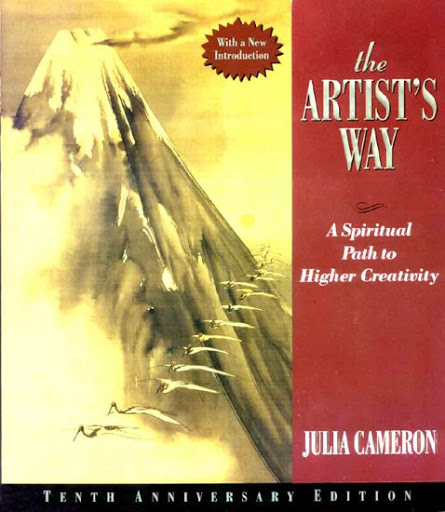
Ironically I also came across a wonderful section on anger in The Artist’s Way: A Spiritual Path to Creativity by Julia Cameron. I say “ironically” because here is a book about creativity. Yet really this book is about so much more.

“Anger is fuel. We feel it and we want to do something. Hit someone, break something, throw a fit, smash a fist into the wall, tell those bastards. But we are nice people, and what we do with our anger is stuff it, deny it, bury it, block it, hide it, lie about it, medicate it, muffle it, ignore it. We do everything but listen to it.

Anger is meant to be listened to. Anger is a voice, a shout, a plea, a demand. Anger is meant to be respected. Why? Because anger is a map. Anger shows us what our boundaries are. Anger shows us where we want to go. It lets us see where we’ve been and lets us know when we haven’t liked it. Anger points the way, not just the finger. In the recovery of a blocked artist, anger is a sign of health.

Anger is meant to be acted upon. It is not meant to be acted out. Anger points the direction. We are meant to use anger as fuel to take the actions we need to move where our anger points us. With a little thought, we can usually translate the message that our anger is sending us.

‘Blast him! I could make a better film than that!’ (This anger says: you want to make movie. You need to learn how.)

‘I can’t believe it! I had this idea for a play three years ago and she’s gone and written it.’ (This anger says: stop procrastinating. Ideas don’t get opening nights. Finished plays do. Start writing.)

‘That’s my strategy he’s using. This is incredible! I’ve been ripped off! I knew I should have pulled that material together and copyrighted it.’ (This anger says: it’s time to take your own ideas seriously enough to treat them well.)

When we feel anger, we are often very angry that we feel anger. Damn anger!! It tells us we can’t get away with our old life any longer. It tells us that old life is dying. It tells us we are being reborn, and birthing hurts. The hurt makes us angry.

Anger is the firestorm that signals the death of our old life. Anger is the fuel that propels us into our new one. Anger is a tool, not a master. Anger is meant to be tapped into and drawn upon. Used properly, anger is use-full.

Sloth, apathy, and despair are the enemy. Anger is not. Anger is our friend. Not a nice friend. Not a gentle friend. But a very, very loyal friend. It will always tell us when we have been betrayed. It will always tell us when we have betrayed ourselves. It will always tell us that it is time to act in our own best interests.”

Anger is not he action itself. It is action’s invitation.”

I also found wisdom about anger in Ed and Deb Shapiro’s article entitled “Ducks Don’t Do Anger” which appeared in the October 30, 2008 issue of the Huffington Post. They write “Trying to eradicate anger is like trying to box with our own shadow, it doesn’t work. Getting rid of it implies either expressing it and creating emotional damage, or repressing it, which just suppresses it until it erupts at a later time. Getting to know and make friends with anger is essential. To make real change we have to change the way we think and react. This is growing roses out of rotting compost, transforming fire into constructive action, using the passion but without the destruction. We need to see what is beneath the anger, what hurt, longing or fear is trying to make itself heard. There may be feelings of rejection, grief or loneliness, so if we repress anger or pretend it isn’t there then all these other feelings get repressed and ignored as well.”

What I have certainly learned from my explorations of facing my own anger and rage is how self destructive this emotion can be if it is suppressed, stuffed and pointed inwards. I am not one to lash out. I have always been one to internalize such feelings. The “goodist” in me was always so afraid of conflict and confrontation. The difficult lesson has been in learning how to constructively communicate my anger in a healthy way. If something upsets me or makes me angry I am learning to make better choices in expressing it. Usually for me it is as simple as speaking up. For example I have learned that telling my husband that I am upset that he didn’t help out in the morning is a much healthier approach, than is harboring my anger which doesn’t resolve anything. It is only by speaking up respectively and sharing my thoughts and feelings that he understands what I am thinking and how I am feeling. Only then can he respond and perhaps do something differently.

Activity ~ Make a list of things that make you angry. Include anything and everything. Here is an example:

Rude drivers
Toilet seat left up
Slow computer
Kids whining and arguing
Television on too loud
Getting to work late
Being interrupted by your spouse or children
Waiting in line

Next review the list and consider why these things make you angry. Sometimes what we think is making us angry, really isn’t the real culprit. Let’s consider rude drivers and toilet seats left up. The key here might be that you are angry that people are not considerate of others. Ask yourself if you are wanting and needing more consideration in your life from your family, your friends and perhaps most of all from yourself. The slow computer might really be more of a reflection of your frustration with not having enough time, or rather feeling like you don’t have enough time. Perhaps you need more “you” time. More time to just be and relax. How can you schedule back and make that happen? If the anger kicks in due to kids whining and arguing, the television being on too loud, and being interrupted by a spouse and children, this could also be a sign that you are in need of more silence in your life and again more private time.
Suggested Reading ~ The Dance of Anger: A Woman’s Guide to Changing the Patterns of Intimate Relationships by Harriet Lerner, Ph.D.

Here is a long excerpt from the beginning of Chapter 1 entitled The Challenge of Anger

“Anger is a signal, and one worth listening to. Our anger may be a message that we are being hurt, that our rights are being violated, that our needs or wants are not being adequately met, or simply that something is not right. our anger may tell us that we are not addressing an important emotional issue in our lives, or that too much of our self–our beliefs, values, desires, or ambitions–is being compromised in a relationship. Our anger may be a signal that we are doing more and giving more than we can comfortable to or give. Or our anger may warn us that others are doing too much for us, at the expense of our own competence and growth. Just as physical pain tells us to take our hand off the hot stove, the pain of anger preserves the very integrity of our self. our anger can motivate us to say “no” to the ways in which we are defined by others and “yet” to the dictates of our inner self.

Women, however, have long been discouraged from the awareness and forthright expression of anger. Sugar and spice are the ingredients from which we are made. We are the nurturers, the soothers, the peacemakers and the steadiers of rocked boats. It is our job to please, protect and placate the world. We may hold relationships in place as if our lives depended on it.

The taboos against our feeling and expressing anger are so powerful that even knowing when we are angry is not a simple matter. When a woman shows her anger, she is likely to be dismissed as irrational or worse.

Why are angry women so threatening to others? If we are guilty, depressed, or self-doubting, we stay in place. We do not take action except against our own selves and we are unlikely to be agents of personal and social change. In contrast, angry women may change and challenge the lives of us all, as witnessed by the past decade of feminism. And change is anxiety-arousing and difficult business for everyone, including those of us who are actively pushing for it.

Thus, we too learn to fear our own anger, not only because it brings about the disapproval of others, but also because it signals the necessity for change. We may begin to ask ourselves questions that serve to block or invalidate our own experience of anger: ‘Is my anger legitimate?’ ‘Do I have a right to be angry?’ ‘What good will it do?’ These questions can be excellent ways of silencing ourselves and shutting off our anger.

Let us question these questions. Anger is neither legitimate nor illegitimate, meaningful nor pointless. Anger simply is. To ask, ‘Is my anger legitimate?’ is similar to asking, ‘Do I have a right to be thirsty?'”