Ever since I was a very little child I had a sense of there being something greater out there, some higher power, that some may refer to as God. I seemed to innately believe in a higher power, but was not being taught or told to believe or think in a certain way. My own mom had been born in Salt Lake City, Utah, into a long line of Mormons. She departed the faith in her early twenties when she had disagreements with the racism that was apparent in the church at that time. Somehow my parents managed to take some community college courses while they raised six children. Both had grown up quickly and had to raise themselves during parts of their childhood. They essentially were both on their own at about sixteen and seventeen years of age. I have recollections of my mom taking a course about world religions. I was fascinated by the subject and at a very early age picked up one of her books called The Religions of Man by author Huston Smith.

I can still also recall, at about age six, waiting at my friend Nancy Sanchez’s house on the way to school. The Sanchez family were Catholic and originally came from South America. Nancy’s mom informed me very matter-of-factly that since I did not attend church I did not believe in God. I know that upon arriving home later that day I told my mom what Nancy’s mom had said to me. It had upset me and I didn’t know why she would say such a thing. In my young mind it made no sense. It was about this same time that I came to learn that some people believed that their God was different from the God other people worshipped, but they knew with certainty that their God was the only true God. Again my young mind thought they were all confused, because I had already figured out that they were all worshipping the same God, that really there were many paths to God, each just as good as the other.
These deep thoughts I had as a child held true for me throughout my life. While in college I had some wonderful roommates who were Christian and very active in a Christian fellowship on campus. I attended gatherings and events with them and thoroughly enjoyed their friendships and activities. There finally came a point though when I attended the lecture of a visiting minister. My question to him, one that I struggled with, was how could they say that a good person who was Muslim, Hindu or Buddhist would go to this “hell” that Christians believe in. It made no logical sense that a loving God would sentence good and kind people to some hellish afterlife simply because they were not Christian. They tried to explain that while it seemed harsh it was the truth.
I knew, knew absolutely, in my heart, that this was untrue. I knew then that I could never be a Christian. I could never embrace a belief system that did not allow for other paths to God. I have met Christians who have chosen their faith for their own heart and soul because it is what calls to them, and they do so without judging others. I admire them for choosing their faith for their individualized path and then respecting, and accepting, that others can choose another path, that has just as much merit as their own.

Yet I also know that it is not uncommon for some people in religions to be absolutely convinced that their way is the only way. I know that this approach of believing that there is only one way is not limited to Christianity, but also permeates many of the other faiths as well. There are Muslims who believe the only true way is to follow Islam. Certainly there are Jews who believe they are the only chosen people. In the world there have been great conflicts and wars between people of different faiths.
Because of my inner sense that there are many ways to reach a higher power, in recent years I have been more drawn to Buddhism. I always feel a kinship when I read the writings of practicing Buddhists. I so love the many messages of the Dalai Lama, especially when he stated “My religion is very simple. My religion is kindness.” I believe that if everyone could agree that each path of spirituality and religion is equal that there would be much less conflict in the world. There would also be less conflict if we all shared a common creed of kindness and respect for one another. I have often struggled with what seems to be the arrogance of those who are so certain and smug that their way is the only one true way to connect with God or that following their religion is the key to being a good and moral person.
A few years back I was entranced by a documentary by National Geographic called The Judas Gospel. I am still surprised that more people have not watched this video or read about it. I know my love of history leads me down such roads, yet this is fascinating historical research that is providing new insight into the past and even biblical history.
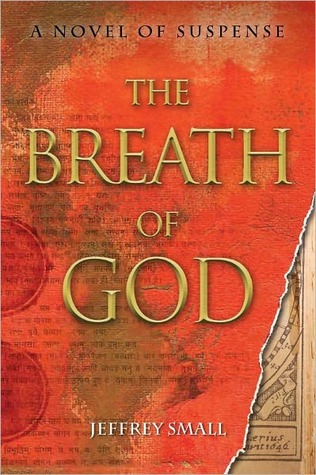
My long held interests in spirituality and faith recently led me to a fascinating novel called The Breath of God by Jeffrey Small. The author graduated summa cum laude from Yale University and magna cum laude from Harvard Law School. In addition, he holds a master’s degree in the study of religions from Oxford University. He is also an acclaimed speaker on the topics of rethinking religion in the twenty-first century and the common spiritual themes in the world’s religions.
While the book is a novel, author Jeffery Small, did draw the inspiration from an actual historical event that took place in 1887. A Russian journalist named Nicolas Notovitch made a discovery in a remote Himalayan monastary. He had been traveling when he fractured his leg and stayed and was cared for in a Buddhist monastary. While there Notovitch had the chance to see manuscripts that documented the life of Jesus and his travels through India and Tibet. Notovitch tried to share these findings with the Christian religious community but was ostracized. He did write a book anyways entitled The Unknown Life of Jesus Christ.
The fictional novel The Breath of God is a story of a contemporary young man who also suffers a leg injury while in search of these lost documents about Jesus. The author does a fine job of weaving a a thrilling story. Here is a fun book trailer that you might enjoy:
I was also intrigued by some of the quotes that the author includes at various chapter beginnings. It does lead one to consider more deeply the ties that could well exist between faiths, ties that some do not choose to recognize.
For example here is a quote from The Tao Te Ching, 6th Century BC
“In the beginning was the Tao.
All things issue from it; all things return to it.
Every being in the universe is an expression of the tao.
The Tao gives birth to all beings, nourishes them, maintains them.”
Now here is a quote from The Gospel according to John, AD 1st century
“In the beginning was the Word, and the Word was with God,
and the Word was God. He was in the beginning with God.
All things came into being through him,
and without him not one thing came into being.
What has come into being in him was life,
and the life was the light of all people.”
Here again is another example as quoted from The Bhagavad Gita, 5th century BC
“I am the source of all things, and all things emerge from me…
Infinite are the forms in which I appear.
I am the self, seated in the heart of all beings;
I am the beginning and the life span of beings, and their end as well…
I am the source of all things to come.”
Then there is this from The Book of Revelation, AD 1st century
“I am the Alpha and the Omega who is and who was and who is to come.”
Lastly I was interested to discover that author Jeffrey Small also writes a column for the Huffington post. I have read several of the articles and each one has left me thoughtful, intrigued, and feeling in alignment with how this man thinks about religion. Here is one example called Faith Is Trusting God, Not Belief in Doctrine that was published on January 19, 2011.
Are you a believer?
Have you ever been asked this question before? Did the question and your search for an answer make you uncomfortable? Did you wonder to yourself what does this question really mean? For me, the answer to all these questions is “yes.”
When I was growing up, I often heard the popular refrain in Christianity that to be “saved” all one needed was to have “faith.” When asked what “having faith” meant, the reply was typically “believing that Jesus is the son of God.” In other words, all we are required to do in order to have eternal life is to believe a certain set of facts about events that occurred over 2,000 years ago, and whatever else we do in our lives (cheating, stealing, murder, etc.) is irrelevant.
I struggled with this issue because logically it didn’t make sense to me. Why would an all-powerful God, who created all of existence, care about a single belief we held? Anthropologists would say that for the vast majority of us, our beliefs are culturally conditioned. Is the Hindu raised in India with little exposure to Christianity who lives an exemplary life going to hell because she does not believe what an American who grows up in the Bible-belt is taught from a young age? What happens when an article of faith (for example, that God created the world in 6 days 6,000 years ago) contradicts what we know from other disciplines like science, history, and archaeology?
The more I thought about this issue, the more it seemed that the formula of “believe in the doctrine of XYZ” and “you will be saved” was little more than a carrot and stick approach to encourage people to conform to the doctrine of whatever authority was making the proclamation. The history of politics has shown that this exact strategy has been employed countless times (often to terrible results) by authoritarian regimes to compel conformity and thus solidify the power of the institution.
The modern view of believing in Jesus in order to be saved has its roots in Martin Luther’s Reformation which responded to the Catholic practice of selling indulgences (paying the church for salvation) by substituting the doctrine of Justification by Faith as outlined by St. Paul. According to this doctrine, we cannot be saved by our good works because at heart we are all imperfect sinners — our works will never be good enough for God. We are only saved through our faith in Jesus.
However, as Luther’s doctrine has evolved over the centuries, it has been distorted so that “faith” has become synonymous with “belief.” What has happened is that a new requirement has been substituted for good works. Making belief a requirement for salvation is just replacing another kind of work — the mental work of belief in something — as a condition to salvation. It is trying to bring in through the back door the type of human action and interference in God’s salvation that Luther objected to with the Catholic church selling indulgences.
So what is the meaning of Luther’s justification by faith? This means simply that we are already saved. We don’t have to do anything for our salvation, and this includes believing in a specific doctrine. When we combine this theory with the conception of God (which I have outlined in earlier posts) as the creative power behind all of existence (instead of a supernatural being who judges our actions like Zeus from the top of Olympus), we can begin to understand how we are already part of the infinite and eternal power of being. The “Kingdom of God” is already present and real because it is the basis that underlies all reality. However, we do not realize that we are already saved — we do not experience this salvation in our day-to-day lives. We live lives in which our egos dominate us and in which we live apart from the ground of reality that is God. Using an analogy from science, we experience only one side of reality — our bodies and the spaces around us — but if we were to look at reality at the molecular level, reality looks very different — what appears solid is actually made up mostly of space and the empty space around us is filled with particles.
The path to salvation thus becomes more like an awakening, an understanding, and an experience of what is already here but we cannot see. The spiritual path (prayer, meditation, fasting, worship, etc.) becomes a mechanism to peal back the onion layers of who we are and what we think the world around us is, so that we can examine the power of God within ourselves, within others, and within existence itself. Salvation is an opening of our eyes and hearts, a new way of seeing the universe.
Faith then is not belief in a certain doctrine about Jesus, but a trust in using him as an example of what it looks like to live a God-centered life. Through the stories in the Gospels (whether or not the details are historical are irrelevant), we can understand the nature of God’s presence within the world and what a God-centered life looks like: a life of humility, compassion, love without boundaries, a life which experiences suffering and doubt, but a life that ultimately participates in the eternal power of God that transcends death.
We’ve all heard the expression “Try it on faith.” This doesn’t mean, “Believe me” but rather “Trust me, and experience it for yourself.” Faith is about testing, questioning, and doubting. In science these qualities lead to greater truths, why shouldn’t the same apply to religion? For me, religion is about embracing the unknown and the difficult — a journey of exploration that never really gets there because ultimately I am finite. Faith is about being comfortable with my doubts because doubt is part of my search for truth. Faith is not a closing of my eyes and mind to the real world, to science, to modern knowledge, or to experience, but it is the opposite: an opening up and a new way of seeing.
Understanding evolves and changes with information; it is open and dynamic. The history of science shows us that whatever our beliefs and theories are today, they will probably be proved wrong over time, and we will then adapt our theories to the new information. Yet in religion we often hold onto cherished beliefs in the face of contrary facts. I think we should borrow from the model of science and allow our religious beliefs to evolve with time as well. But we should be cognizant of the difference between scientific knowledge and understanding through faith and religious experience. I view faith as another form of knowledge that is based more on insight and wisdom. It is using intuition as a way of understanding versus pure reason. But it should not be in conflict with reason, science, and experience. Therefore when I pose the question at the top of my blog “What do you believe?”, I do so as an invitation to explore your beliefs, to question them, and to engage in a deeper search for meaning that may mean confronting uncomfortable facts and evolving your views.

What do you believe?
Are there any thoughts or emotions that have been drawn out by the post?
Were you raised with a particular religious faith?
Is it one you still practice?






 We Are All Meant to Shine!